 My Bookshelf
- Home
- Securities Regulation, Cases and Analysis
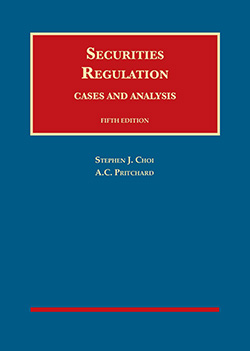
Securities Regulation, Cases and Analysis

This casebook offers a clear and concise introduction to the economics and regulation of securities markets, with a single-minded focus on disclosure and the economics of disclosure. It is concise, easy to read, and student friendly.
The casebook makes securities regulation easy to teach and understand. It focuses on the important principles students need to understand to be effective corporate lawyers. The chapters are organized around motivating hypotheticals that illustrate the various issues relating to each chapter’s topic. These hypotheticals make it easier for the students to follow the material. In addition, they are a useful teaching device allowing students to grapple with issues that they are likely to face as corporate lawyers. The supporting materials for the book also provide role-playing and prospectus-drafting exercises to involve students in learning tedious securities materials (e.g, prospectuses). The book avoids policy debates and instead focuses on understanding the rules as they are. It contains tables and charts to organize complicated material, along with a comprehensive set of PowerPoint slides for presenting the material.
This casebook focuses on overarching topics such as materiality and the definition of a security up front, before delving into the details of how the Securities Exchange Act of 1934 and the Securities Act of 1933 operate. The Sarbanes-Oxley, Dodd-Frank, and JOBS Act (JOBS Act), are all covered, with separate chapters devoted to enforcement and gatekeepers. The Fifth Edition has been revised to reflect significant developments in securities fraud litigation and insider trading, as well as new material relating to cybersecurity and cryptocurrency.
Imprint: Foundation Press
Series: University Casebook Series
Publication Date: 05/06/2019
Stephen J. Choi, New York University School of Law
A.C. Pritchard, University of Michigan Law School
CasebookPlus™
This title is available in our CasebookPlus format. CasebookPlus provides support beyond your classroom lectures and materials by offering additional digital resources to you and your students. Anchored by faculty-authored formative self-assessments keyed to our most popular casebooks, CasebookPlus allows students to test their understanding of core concepts as they are learning them in class – on their own, outside of the classroom, with no extra work on your part. CasebookPlus combines three important elements:
- A new print or digital casebook
- Access to a downloadable eBook with the ability to highlight and add notes
- 12-month access to a digital Learning Library complete with:
- Chapter questions keyed to the casebook
- Black Letter Law questions (available in select subjects)
- Subject area review questions for end of semester use
Leading digital study aids, an outline starter, and audio lectures in select subjects
Students can still utilize CasebookPlus digital resources if they’ve purchased a used book or are renting their text by purchasing the Learning Library at westacademic.com.
With CasebookPlus, you can customize your students’ learning experience and monitor their performance. The quiz editor allows you to create your own custom quiz set, suppress specific quiz questions or quiz sets, and time-release quiz questions. Additionally, the flexible, customized reporting capability helps you evaluate your students’ understanding of the material and can also help your school demonstrate compliance with the new ABA Assessment and Learning Outcomes standards.
Sample Syllabi
PowerPoint Presentations and Appendices
Chapter 1 PowerPoint Presentation
Chapter 2 PowerPoint Presentation
Chapter 3 PowerPoint Presentation
Chapter 4 PowerPoint Presentation
Chapter 5 PowerPoint Presentation
Chapter 6 PowerPoint Presentation
Chapter 7 PowerPoint Presentation
Chapter 8 PowerPoint Presentation
Chapter 9 PowerPoint Presentation
Chapter 10 PowerPoint Presentation
Chapter 10 Appendix (Word doc)
Chapter 11 PowerPoint Presentation
Chapter 11 Appendix (Word doc)
Summary of Changes
Editorial changes throughout to improve readability
Chapter 1
Updating to reflect developments in the securities markets.
Chapter 2
Added section on The Reasonable Investor
Added U.S. v. Litvak
Chapter 3
Omitted SEC v. Edwards
Added Avenue Capital Management II, L.P. v. Schaden
Added section on Cryptocurrency
Chapter 4
Added section on Cybersecurity
Added section on Smaller Reporting Companies
Omitted In re Oil States Int’l
Added In re BHP Billiton
Chapter 5
Added Indian Pub. Ret. System v. SAIC, Inc.
Added In re Vivendi Sec. Litig.
Added Mineworkers Pension Scheme v. First Solar, Inc.
Added note discussing Lorenzo v. SEC
Chapter 6
Omitted United States v. Newman
Added Salman v. United States
Added United States v. Martoma
Added Lowinger v. Morgan Stanley & Co.
Chapter 7
No significant changes
Chapter 8
Added section on Securities Act claims in State Court
Added Federal Housing Finance Agency v. Nomura Holding America, Inc.
Chapter 9
Revised to reflect revised Rue 147 and Rule 147A
Chapter 10
No significant changes
Chapter 11
Omitted Business Roundtable v. SEC
Chapter 12 (Chapters 12 and 13 swapped)
Omitted Washington Public Power Supply System Sec. Litig.
Omitted KPMG LLP v. SEC
Added WHX Corp. v. SEC
Added discussion of Elon Musk administrative proceeding
Added SEC v. Jensen
Chapter 13
Added Altman v. SEC
Deleted Wiest v. SEC
Added Digital Realty Trust, Inc. v. Somers
Learn more about this series.
Access Denied
Law School Faculty - Sign in or Create an Account to access this content. Law faculty who have created an account can sign in after receiving email notification that registration has been approved. Email accountmanager@westacademic.com or call 800-313-9378 for assistance.
Other Higher Education Faculty who wish to access digital review copies or teaching resources should contact their West Academic Account Manager at college@westacademic.com or 800-360-9378.
Adopters Only
This content is intended for adopters only. Sign in or Create an Account to access this content. Law faculty who have created an account can sign in after receiving email notification that registration has been approved. If you are an adopter who is unable to access this content after signing in, contact your account manager for assistance at accountmanager@westacademic.com or call 800-313-9378 for assistance.
Access Denied
Sign in or Create an Account to access this content. Faculty who have created an account can sign in after receiving email notification that registration has been approved. Contact us for assistance.
Law School Faculty: email accountmanager@westacademic.com or call 800-313-9378.
Other Higher Education Faculty: email college@westacademic.com or 800-360-9378.
Access Denied
Higher education faculty who wish to view this document should contact their West Academic Account Manager at college@westacademic.com or 800-360-9378.